Save the Cat
What an encounter with a stray cat taught me about character

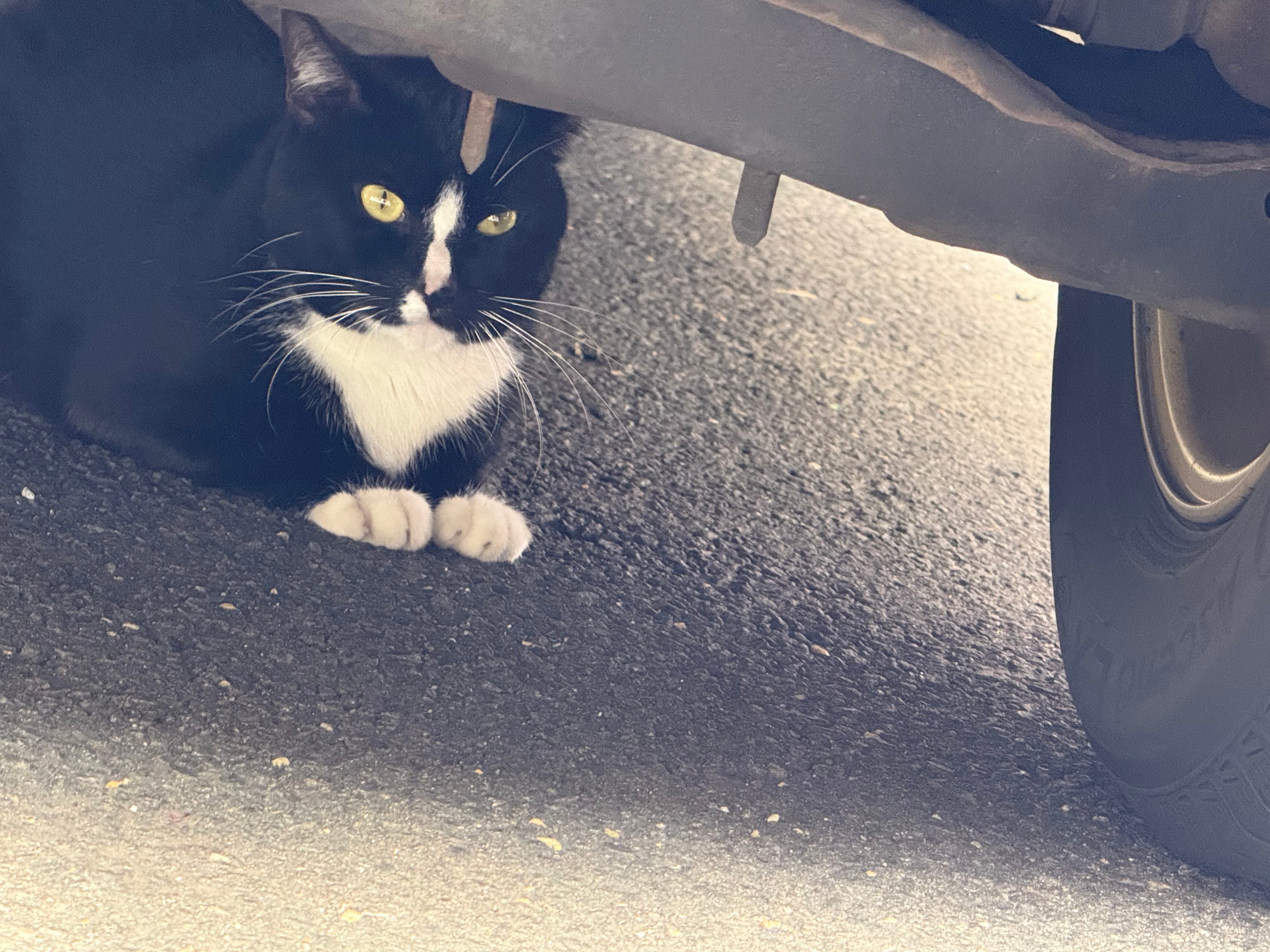
I learned about something called the Cat Distribution System last year after my cat died, the idea that sometimes the universe delivers you a cat and that is your cat. The Cat Distribution System; look it up on TikTok. I have new cats now, but that might have been what I was thinking about when I spotted the cat crouched under a car parked on a street in Stamford.
Ken was the one to point it out—the car, not the cat. “That might be a nice car for Sam,” he said because our son Sam is in the market for one—a car, not a cat. We were with our other son Oliver. The three of us had just left a movie and were headed to dinner but now we crossed the street to take a closer look.
The cat was a regular-looking cat, black with touches of white. He seemed fairly clean, thin but not malnourished. His white feet were a little dirty. Ken and Oliver stayed with him while I walked into a nearby liquor store and restaurant to see if anyone knew who he belonged to. They did not. Next I called Animal Control, but it was closed for the night. Same with my vet. The emergency vet I called said if I could get the cat to them, they could check and see if he had a microchip, but if he didn’t they couldn’t take him because they didn’t take strays. I hung up.
Back on the street, a few people stopped by: a guy who’d stepped out for a smoke and brought us some cat treats. A woman on her way to dinner who told us her daughter rescued animals in Chicago. The owner of the car who was also the manager of the restaurant; she wished us good luck before heading back to work. The various passersby who stopped to ooh and ahh or say “Cute cat” before moving on with their nights. The people who ignored us completely.
As they moved in and out of the scene, I wondered how I had become involved in this drama. The Cat Distribution System? That isn’t even a thing! And besides, I already had cats—two of them!—at home. But my impulse to find someone else to put in charge—shopkeepers, vets, Animal Control—to find an expert, someone who knew more than I did: that tells you something about my character. I didn’t want to be in charge of the cat’s destiny, I wanted to be a bit player. If I were a character in a novel, you would know something about me through my actions, by the way I responded to crisis.
Pretty soon, a plan emerged. A young couple who lived nearby found a friend who agreed to keep the cat overnight, then deliver him to Animal Control in the morning. They had a cat carrier but now a new problem presented itself: how to capture the cat.
While we were discussing his fate, the cat had been darting out from under the car to grab a treat or two; at one point, he sauntered onto the sidewalk to chase a bird. But then, just as quickly, he’d dart back under. Ken had decided he would be the one to grab him when the time was right. He got prepared by putting a long-sleeved shirt—borrowed from the young couple—over his t-shirt to protect himself from scratches. All of this is very in character for Ken, who is a man of action but also one who thinks a few steps ahead. I, in the meantime, positioned myself on the other side of the car, away from the cat, and started swinging my handbag sort of randomly, hoping it might scare the cat out the other side.
But now onto the scene came a new character, a woman I’ll call Anna. Anna was short and had long thick red hair. She was wearing a green tank dress with an Eagles logo. It turned out Anna had been sitting in the restaurant eating dinner with her husband and another couple when she spotted us through the window. But I didn’t know that at the time. All I knew was that suddenly Anna was there and Anna was all in. She threw herself down onto the ground, got eye level with the cat, her hands and knees pressing into the asphalt. If Anna were a character in a novel, she could not have done more to announce her character through action.
If you’re a writer, you are likely familiar with the book Save the Cat. First published as a guide for screenwriters, it has since been adapted for novels, TV writing and other sub genres (horror, YA). Save the Cat sets out a series of beats to follow when telling a story—catalyst, midpoint, dark night of the soul etc—but the name of the method comes from a screenwriting beat: the idea that early in a screenplay, you should have your main character do something heroic (ie save a cat) in order to get the audience to root for him or her. If Anna and I had been characters in a novel or film, it’s clear which one of us the audience would have been rooting for. While Anna threw herself into the scene with the commitment of a true hero, I hung on the sidelines, a minor figure at best.
I have a note above my desk, one of those encouraging post-its writers often have. It says: “Change occurs in the cauldron of crisis.” Turns out character is revealed there, too.
And so it was Anna to whom the cat ran when I finally succeeded in scaring him out from under the car. Anna, all bare armed and bare legged, was the one to grab him while Ken leaned in to help and Oliver and I scrambled over to right the carrier that had gotten knocked over in the melée. And the cat? Yeah, he was having none of it. By the time Anna finally gave up and dropped him, she had blood running down her arm. Ken, for his efforts, had a scratch or maybe a bite on his wrist that had broken the skin.
We hurried Anna into the restaurant’s bathroom. Ken helped her wash up while I asked the restaurant staff for a first aid kit. Now onto the scene appeared Anna’s husband looking stunned and aimless, watching while a stranger—Ken—tended to his wife’s injuries. They lived nearby so I directed him to go home and get peroxide because the restaurant didn’t have any. He looked at Anna blankly, so she told him what the bottle looked like and where he could find it. If I had to guess, I would imagine this was in character for him, and maybe for their dynamic as a couple.
While we waited for him to return, Ken told Anna that she was brave, that she was a badass. He told her she would likely be very successful. I agreed, in part. Anna was brave in a way that I was not, that I would never be. But she was also reckless. She had put herself in danger and gotten hurt.
“You need to be more careful,” I told her. She looked at me pale, in pain, scared. You don’t have to throw yourself into every fight, I told her. You need to protect yourself more. I believed this to be true. Anna should not have run out of the restaurant and tried to grab a strange, possibly feral cat, wearing only a tank top. If she were a character in a novel, this moment might come to mean something to her, a time she learned to be more careful. Maybe that day with the cat would change how she acted in the future. Maybe my words, the wisdom of an older woman, got through to her. Or maybe not.
I talk to a lot of writers who have a hard time with plot. My novels are quiet, they tell me. I’m not that interested in plot. Fine, but a novel needs something driving it, an engine, a motor, and that motor can be thought of as plot. But plot doesn’t have to be car crashes or explosions. You don’t have to find a dead body on the first page. It can be as simple as a character acting out of character—if I’d grabbed the cat for example. Or Anna acting in character—grabbing the cat—and something happening to her as a result.
What I mean is that novels are made up of characters, characters doing things that are in character as well as things that aren’t—and it’s often that break in character where the fun happens.
Think about character as it presented itself that night: Anna running out of the restaurant and throwing herself on the ground, grabbing the cat without protecting herself—all of that tells you something about her character. Me wandering around looking for help, making phone calls, asking experts, keeping my hands clean: that tells you something about my own.
Ken behaved in a way true to his character as well. He got down on the ground, started problem solving. He got prepared. I’m fairly sure that had he managed to get his hands on that cat before Anna, he would have been able to get him in the carrier (then again maybe not—that cat was kind of an asshole). But he would have tried a lot harder than I would have. But maybe not as hard as Anna.
And what about the cat, who was very much a character in this story, protagonist or villain depending on how you looked at it? Well, after the carnage we all agreed: fuck him. He didn’t appear to need or want the help being offered. In any event, we’d done all we could do, or at least all we were willing to do.
For their trouble, Anna and Ken both ended up in the ER where they received rabies and tetanus shots as well as ten days of antibiotics. Turns out rabies is very rare—fewer than ten people die of it a year—but if you contract it, you’re pretty much dead.
In the morning, Ken asked if I thought getting the shots had been overkill. It had been painful and unpleasant and he still had to go back for three more. I thought for a moment and said no, I didn’t think it was overkill. “If it were me…” I started to say, but then I stopped. Because it wasn’t me. Not only that, it would never have been me because I would never have put my hands on that cat like Ken did, would never have thrown my body onto him like Anna did. So the question of what I would have done in response was a pointless one because I would never have even tried.
Fellow sideliner who wouldn't have touched the feral cat with a 10 ft pole 🙋♀️ Love this & love being one of the characters who doesn't end up in the hospital
I loved that I got a story and a craft lesson all in one. You continuoulsy make life better : )